It’s no longer all about cost savings; finance and accounting outsourcing is about working smarter. By 2026, almost 80% of routine accounting and bookkeeping tasks can be automated, while many professionals are now working with AI on a daily basis.
And this transition is helping companies receive more timely reports, fewer errors and better compliance. Businesses are turning big through the help of outsourcing experts who take care of complex tasks. With it, you can focus more on growth rather than being tied down in daily finances.
What is Finance and Accounting Outsourcing?
Finance and Accounting Outsourcing (FAO) refers to handling things like bookkeeping, payroll, tax filing, and reporting to a third-party expert. Utilizing an advanced tool and financial compliance automation for BPO, these service providers enhance the accuracy and precision of data sharing. It ensures that the businesses remain compliant, save time, and reduce operational hassle.
How Does AI-Powered Finance and Accounting Outsourcing Ensure Compliance and Reporting?
AI is interfering how businesses handle compliance by using speed, intelligence and reliability to enable automated reporting, as well as data analysis in real-time. This allows businesses to accomplish compliance objectives while lowering the risk of human error, as well as increasing accuracy, and reducing ongoing staffing of regulatory compliance employees.
· Automated Data Processing and Accuracy
AI in accounting s being used to analyze, automate, and track compliance for invoice receipts and transaction data. Thus, the use of AI will reduce the number of errors committed by humans when completing tasks. Furthermore, businesses need to create and maintain accurate financial reports in order to remain compliant and create said financial reports within a defined time period.
· Real-Time Monitoring and Compliance Checks
AI can analyze financial transactions of a business in seconds and determine if any unusual transactions occurred. In addition, using the real-time visibility provided by outsourcing companies that make use of AI allows businesses the ability to discover early warning flags of compliance issues much quicker. Thus, businesses would be able to take proactive steps to avoid penalties and other difficulties associated with the regulatory agencies.
· Smart Audit Trails and Documentation
AI provides a complete and traceable audit trail for any part of the financial transaction processing. This will provide outsourced audit support services with the ability to provide an organized and structured set of documents when completing the audit. Furthermore, the AI tools will make the preparation of the audit process much simpler. It enables them to demonstrate compliance during the auditing process with greater confidence.
· Faster and More Accurate Financial Reporting
AI is enhancing the efficiency of the generation of aggregated data and reports that will be produced by advanced financial reporting services. This way, businesses will continue to meet compliance with their financial statement creation processes. It will also help business management to obtain timely and complete data to make informed decision-making at the strategic level.
· Fraud Detection and Risk Management
AI systems evaluate trends and detect anomalous behavior immediately. Financial compliance services help enterprises detect any possible fraud early and reduce financial risks. Such a proactive approach helps to tighten locks internally and also ensures that regulations are not broken.
· Regulatory Updates and Adaptability
AI tools will keep up with changes and automatically update processes according to the changing laws. This is particularly useful in accounting outsourcing services, where the manual tracking of regulatory updates can cause a strain. But, with it, organizations stay aligned with the newest mandates without constantly having to involve in-house teams.
· Predictive Insights for Better Decision-Making
Accounting BPO services help businesses forecast financial patterns, reduce risks in advance, and plan effectively. This proactive mindset improves adherence while enabling more insightful financial planning and sustainable growth.
The AI-Powered Outsourcing Trends in Accounting
Here are the best AI-powered outsourcing trends in accounting to know about in 2026.
· Human Expertise + AI is the New Standard
It is not enough to rely on AI, the combination of it with human judgment results in better outcomes. Accountants are trained to extract meaning from datasets, further helping businesses and clients make more informed decisions based on better data filters.
· Real-Time Data and Predictive Insights
AI tools conduct instant data analysis of the financials and suggest predictive insights. With financial reporting services, businesses can transition from mere historical reporting to undertaking proactive decisions.
· Cloud Integration and Seamless Collaboration
Modern outsourcing today depends on cloud-based platforms for instant collaboration. In AI in accounting, tools such as cloud ERPs and workflow systems make sure there is effortless data sharing. It further guarantees more transparency and better coordination between in-house teams and outsourced professionals.
Conclusion
In summary, finance and accounting outsourcing is emerging in the form of AI-powered solutions to redefine everything. It changes how businesses oversee compliance, reporting and day-to-day operations.
Plus, it uses automation and expert oversight to ensure accuracy, efficiency, and scalability. With the continuous evolution of AI, companies that adopt these solutions will enhance financial control, mitigate risks and remain competi tive.
A long time ago, companies stopped outsourcing only simple jobs. Now they also hire other people to do work that requires a lot of thinking. In this case, knowledge process outsourcing comes in handy. It goes beyond simple tasks and focuses on complex, high-value jobs that need knowledge, analysis, and experience.
KPO services, on the other hand, do more complicated tasks like medical study, financial modeling, and data interpretation. It helps businesses cut costs, find skilled workers, and work more efficiently without having to build big teams in-house.
What is Knowledge Process Outsourcing?
Delegating knowledge-intensive jobs to outside experts is the main component of knowledge process outsourcing. These jobs need good judgment, technical know-how, and knowledge of the business.
Here are some common KPO tasks:
- Reporting and analyzing money issues
- Analysis of the market and business
- Research and paperwork for the law
- Analysis of medical data and clinical proof
This is why KPO is so important in fields like healthcare and business.
KPO in Finance: Precision and Data-Driven Decisions
The finance industry has to deal with a lot of data all the time, rules and regulations, and the need to make correct predictions. That’s why finance outsourcing services are useful.
Companies hire others to do things like:
- Researching and valuing stocks
- Risk review and reporting on compliance
- Analysis of investments
- Predicting the budget
Businesses can make faster and better choices with the help of KPO services for financial analysis and reporting. They bring advanced tools and knowledge about the subject that many businesses don’t want to build themselves. The ability to grow is another big benefit. Financial companies don’t have to hire full-time workers to handle busy times. Especially for investment firms and fintech businesses, this makes financial data outsourcing a practical choice.
KPO in Healthcare: Accuracy and Compliance Matter
It’s even more important in healthcare. Not only do mistakes cost money, they can also be dangerous. This is why the number of healthcare outsourcing services keeps going up.
In health care, KPO workers handle:
- Coding and payment for medical care
- Handling of clinical data
- Help with research and drug creation
- Analysis of patient data
Healthcare businesses and hospitals can focus on taking care of patients while experts handle work that involves a lot of data with healthcare knowledge process outsourcing services. The healthcare data services field is another important one. Some of these are managing, studying, and keeping safe large amounts of patient data. Because of strict rules about compliance, hiring trained pros to do the work cuts down on risk and boosts efficiency.
Why Businesses Choose KPO?
There are a few reasons that make sense. Not a big surprise.
- Savings on Costs: It costs a lot to hire and train experts. KPO makes that easier.
- Access to Expertise: Businesses can hire skilled workers without having to wait a long time.
- Be More Focused: Internal teams can focus on tasks that are important to the business.
- Ability to Grow: Workloads can go up or down without affecting operations.
- Faster Turnaround: Providers with more experience get results faster because they already know how to do things.
KPO vs BPO: The Real Difference
People often mix them up. The difference is simple.
| Factor | BPO | KPO |
| Nature of Work | Routine | Analytical |
| Skill Level | Basic to moderate | High expertise |
| Examples | Data entry, support | Financial analysis, medical research |
| Value | Cost-saving | Value creation |
So, while BPO services lighten the load on operations, KPO services help with business planning and making decisions.
Challenges to Consider
Things aren’t always easy.
- There are risks to data protection, especially in healthcare and finance
- Depending on outside providers
- Gaps in communication between areas
- Not being able to trust the seller can cause problems with quality control.
Still, most of these issues are caused by choosing the wrong provider and not being clear about how things work.
Conclusion
Aside from being a type of BPO, knowledge process outsourcing is more than that. This is a move toward outsourcing that is better. Businesses no longer just want to save money. What they’re buying is knowledge.
Through financial data outsourcing and advanced analytics, it improves decision-making in finance. Structured healthcare data services and compliance-driven processes make sure better results in healthcare. So, if the job needs analytical thinking, correctness, and care, it probably falls under KPO. That’s all there is to it.
As businesses attempt to keep up with ever increasing volumes of digital data, they have begun to embrace advanced automation technology. In the year 2026, hyperautomation will enhance the way in which organizations automate their processes through access to new forms of artificial intelligence, robotic process automation, and analytics. The hyperautomation in outsourcing will create highly efficient end-to-end processes for capturing, validating, and processing data. This will enable organizations to realize much faster, smarter strategies for managing their data.

Understanding Hyperautomation and Its Growing Role in Outsourcing
Hyperautomation is defined as the collaboration of multiple forms of advanced technology. It means to automate complex business workflows through the use of AI, robotic process automation, machine learning, and analytics. Hyperautomation differs from conventional automation, which typically relies on the repetitive execution of tasks. It uses multiple technologies to link together to form a seamless automated workflow from beginning (input data) to end (processed output).
The outsourcing industry is harnessing the benefits of hyperautomation by utilizing AI data entry automation. It automates the processing of significant volumes of both structured and unstructured data, both rapidly and accurately.
Key Technologies Driving Hyperautomation in Data Entry BPO
Hyperautomation achieves higher levels of efficiency through the integration of intelligent technologies within an outsourcing company’s BPO workflow. Integrating these technologies into the BPO workflow will result in more enhanced automation and, therefore, ensure higher levels of precision.
AI-Powered Data Processing
AI (Artificial Intelligence) enabled data processing is possible through using artificial intelligence to analyze, interpret, and extract valuable information from complex datasets. It provides a solution for outsourcing providers by enabling them to process large volumes of documents with minimal human effort.
Robotic Process Automation (RPA)
The use of RPA or Robotic Process Automation enables seamless repetitive data extraction, form completion, as well as updating databases via software bots. When combined with AI, the AI RPA benefits for data entry BPO services can provide significant operational efficiency improvements. It offers assistance for outsourcing providers to provide faster results with high levels of quality and efficiency.
Machine Learning and Predictive Analytics
The use of historical data to create machine learning models can provide the basis for improved automation in the future. Through continuous machine learning model enhancement, coupled with predictive analytics, it helps you to identify new insights to help drive automation.
How Hyperautomation Is Transforming Data Entry Outsourcing Operations
The potential of hyperautomation in data entry outsourcing 2026, transforms traditional data entry outsourcing practices through enhanced intelligence, efficiency, and scalability. Leveraging advanced analytics with automation tools allows outsourcers to implement top-quality management of data while improving their ability to provide quality outcomes for their clients.
Accelerated Data Processing
The use of automation technology will greatly reduce the amount of time needed to process large quantities of data. With intelligent systems capable of capturing, validating, and transferring data between different platforms in a matter of seconds, outsourcers can provide high-volume automated data entry services while improving operational efficiency.
Greater Data Integrity
Human error in the manual data entry can introduce high costs. With the implementation of hyperautomation 2026, the risks associated with human error can be greatly reduced. The AI-enabled data validation mechanisms allow for real-time identification of inconsistencies, omissions, and incorrectly formatted data. All of these measures substantially improve the quality of data being entered into enterprise-wide systems.
Cost Efficiency for Businesses
The implementation of automation tools will significantly reduce manual labor requirements and corresponding reductions in operational expenses for both the outsourcer and the client. The client will achieve faster throughput time, reduced costs associated with error correction, and improvements in employee productivity. All of which leads to greater overall cost-effectiveness of outsourced data services.
Seamless Cross-Hybrid Platform Integration
With the demand for data to flow seamlessly between many digital platforms, modern-day outsourcing processes require hyperautomation solutions. This offers seamless integration with enterprise application software, CRM systems, and cloud computing platforms through intelligent process automation.
Conclusion
By integrating AI, automation, and analytics, hyperautomation is altering how data entry outsourcing will operate. With ongoing technological change, it is expected that providers of outsourcing services will provide global businesses with an increasingly efficient, secure, and scalable way of processing data.
Data entry has been an important part of outsourcing business processes for a long time. But old-fashioned manual processes aren’t able to keep up with the amount of data and the need for accuracy that today’s needs. These days, companies need to be able to turn things around faster, be very precise, and be able to expand their operations.
This is how AI data entry is changing the world of outsourcing. Companies are getting more productive, saving money, and being able to change their operations more quickly when they combine human knowledge with machine intelligence. Workflows that use AI are quickly becoming the next big thing in commercial BPO.
What Is AI-Augmented Data Entry?
AI-augmented data entry combines smart robotic technologies with human reviewing. Instead of replacing people completely, AI does boring, repetitive jobs while skilled workers handle the rare cases and make sure the quality is good. Typical features of contemporary AI-driven BPO data entry solutions are:
- Optical Character Recognition (OCR)
- Machine learning models
- Natural language processing
- Smart validation rules
- Workflow automation engines
This hybrid model is faster than fully manual methods because it doesn’t sacrifice accuracy.
Why Traditional Data Entry Is No Longer Enough
Businesses have used manual data entry for decades, but it has a lot of problems. As a business grows, these problems become more clear. Problems that often come up in manual BPO workflows include:
- High error rates due to human fatigue
- Slow processing speeds
- Rising operational costs
- Difficulty handling unstructured data
- Limited scalability during demand spikes
To stay competitive, many businesses are moving toward data entry automation because of these problems.
How AI Is Transforming BPO Data Entry
The rise of AI in BPO isn’t just about automating tasks; it’s also about making things better in smart ways. AI systems can now read papers, figure out what they mean, and check the accuracy of the information they find. Some of the most important things that AI-powered workflows can do are:
- Intelligent Document Extraction: Invoices, forms, emails, and scanned papers can all be gathered by AI tools using intelligent data processing. This makes typing much easier by hand.
- Automated Validation: These days, automated data entry systems find mistakes right away. This makes the data better and cuts down on mistakes that cost a lot later on.
- Continuous Learning: If you give AI models new data, they get better. AI data entry systems, on the other hand, get faster and more accurate over time, while human processes stay the same.
- Faster Turnaround Times: Large data volumes can be processed in hours rather than days with AI-powered outsourcing.
Business Benefits of AI-Augmented Outsourcing
Businesses that use AI augmented data entry outsourcing services report significant improvements in all areas of their operations. The most important benefits are the ones below:
- Higher Accuracy: Through rule-based and predictive confirmation, AI cuts down on human mistakes.
- Significant Cost Savings: Automation makes work easier while also speeding things up.
- Improved Scalability: Businesses don’t have to hire big temporary teams to handle holiday spikes.
- Faster Processing Cycles: With automated data entry processes, turn-around times drop by a huge amount.
- Better Compliance and Audit Trails: AI systems keep organized logs, which makes it easier to find things.
Finance, healthcare, transportation, and e-commerce are some of the industries that are most interested in AI-enabled outsourcing because of these benefits.
Real-World Use Cases Across Industries
AI-augmented BPO is already providing value in a number of areas.
Finance and Banking
- Invoice processing
- KYC document capture
- Loan application data extraction
- Claims processing
Healthcare
- Patient record digitization
- Medical billing support
- Insurance form processing
E-commerce and Retail
- Product catalog updates
- Order form processing
- Vendor data management
In every situation, AI-driven BPO data entry solutions assist businesses in processing large amounts of data more quickly and consistently.
The Human Plus AI Advantage
Despite the fast growth of automation, human knowledge is still very important. Having a person in the loop is what the best companies do. Here’s why people are still important:
- Handling complex edge cases
- Managing low-confidence AI outputs
- Ensuring contextual accuracy
- Performing final quality assurance
- Training and refining AI models
When used in this way, AI in BPO is really strong. In this case, machine speed and human perception work together.
What to Look for in an AI-Enabled BPO Partner
To get the most out of AI augmentation, you need to pick the right outsource partner. Key criteria for evaluation:
- Proven experience in AI-powered outsourcing
- Strong data security and compliance frameworks
- Customizable workflow automation
- Human-in-the-loop quality controls
- Transparent pricing models
- Scalable cloud infrastructure
The best long-term return on investment will come from vendors with mature intelligent data processing skills.
Conclusion
Future of contracted BPO services is changing because of AI-powered data entry. When businesses use automation along with human oversight, they can get faster working, higher accuracy, and better operational efficiency. It is no longer a choice to switch to AI-driven BPO data entry solutions; it is a strategic necessity. Companies that use this hybrid model now will be better prepared to handle the data needs of tomorrow with trust and speed.
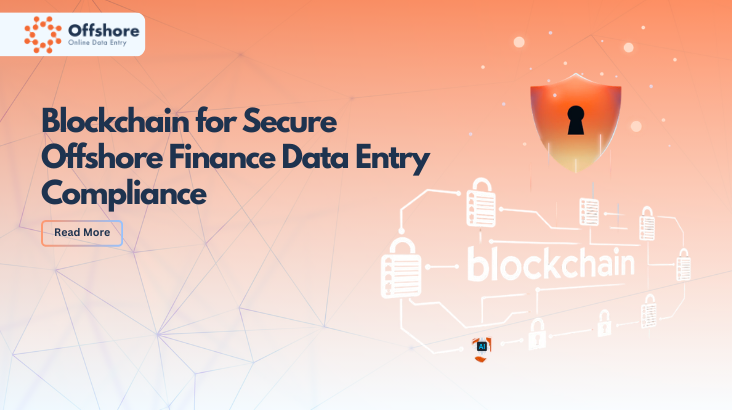
As financial operations develop across borders, data accuracy and compliance risks are skyrocketing. Today’s organizations require a solution that can keep sensitive records safe while permitting the flexibility of offshore working methods. The introduction of blockchain finance security has created a secure environment, particularly when large blocks of offshore financial data entry are processed by offshore locations under strict regulatory demands.
How Blockchain Works in the Finance Field?
Blockchain provides a unique way to securely store financial data as a distributed digital ledger. It basically records data across a web of multiple nodes. Here, transactions are confirmed before they are saved to the ledger, thus reducing manual input and increasing blockchain compliance for the offshore finance operations.
Immediate Verification of Transactions
Blockchain verifies any financial transaction through consensus amongst the nodes in that network. This happens almost immediately upon entering the transaction. As it occurs instantly, there are fewer delays in receiving confirmations of financial transactions, which results in fewer manual verification errors.
Decentralized Ledger
The information in the blockchain is stored across multiple independent nodes. Here, each node is independent from the others. Therefore, it is highly impossible for one entity to manipulate the record. This increases the level of trust and reliability amongst the users.
Smart Contracts
Smart contracts allow automation of the banking and finance data entry. They enforce compliance right from the time when the financial information is recorded to the time it is approved and reported. They do this without any human intervention.
Immutability
Once a record is added to the blockchain, it cannot be changed or deleted. This results in the creation of an everlasting, permanent audit trail. This adds significant value for the organizations that take aid from offshore financial operations.
Enhanced Security
The secure use of cryptography protects the data that is sent back and forth and stored on the blockchain. Therefore, it provides much better protection against unauthorized access and breaches.
Top Benefits of Hiring Blockchain Finance Data Entry BPO
Hiring a blockchain finance data entry BPO will help your organization cope with large and complex offshore workloads securely. By working with specialized providers who combine blockchain technology and industry knowledge, you’ll be assured of accurate, compliant, and scalable high-volume offshore financial data entry services.
Secure Finance Data Integrity:
Maintaining integrity in financial records is important. Here, blockchain provides a means of preventing unauthorized modifications to the record.
Improve Transparency of Finance Data:
Blockchain ensures every transaction is recorded and traceable. This creates a high degree of accountability for offshore teams.
Enhance the Security via Cryptography
Through the use of advanced encryption techniques, sensitive records are protected from being compromised. This eliminates the risk of data tampering during the offshore data entry process.
Provide Audit Efficiency
Because of the immutable nature of the blockchain, faster audits can be conducted. This immensely helps all the offshore financial data outsourcing.
Increase Privacy of Finance Data
Controlling access to financial data, as well as ensuring confidentiality, is a key component of blockchain-aided BPO. Go for a reputable BPO partner to ensure an end-to-end secure data entry services.
Key Elements of Blockchain Supporting Secure Offshore Finance
The architecture of blockchain technology provides an ideal way to ensure secure offshore financial operations. The technical capabilities of blockchain provide the building blocks for greater compliance, accuracy, and reliability in modern-day financial data outsourcing.
- Blocks and Hash Functions: Securely link financial records in a chain of unchangeable events.
- Consensus Mechanisms: Provides verification of the accuracy of the data before it is accepted across the network.
- Encrypted Data: Prevents an individual or organization from accessing or manipulating the data without authorization.
- Public Keys: Allow visibility into the history of transactions without revealing personal or proprietary information.
Conclusion
By increasing compliance with offshore financing, the blockchain will increase security, transparency, and auditability through the use of expert outsourcing. This joint venture will thus produce quality and future-proof financial data entry operations.
Master Data Management (MDM) is a critical process that helps in maintaining data accuracy and consistency. Effective data management enables businesses to make informed decisions. Hence, master data management outsourcing is preferred by many organizations to concentrate on core business activities.
What Is Data Entry BPO in MDM?
Data Entry Business Process Outsourcing (BPO) is the process of outsourcing data entry tasks to experts. Data entry BPO, in the context of MDM, is used to support the capture, consolidation, and updating of key information.
For instance, MDM data entry services help organizations ensure that the master data is accurate and standardized across platforms. Outsourcing these tasks reduces the workload and allows internal teams to focus on higher-value data governance activities. As a result, the businesses will be able to improve efficiency while having better control over data.
Key Components of Master Data Managed via BPO
Many types of core data are managed through outsourced services. These components are the backbone of the enterprise data infrastructure.
· Customer Data
Customer data consists of names, contact information, and interaction histories that create complete and accurate customer profiles. In addition, accurate customer data allows for personalization, minimizes errors, and maximizes engagement with various online touchpoints. Thus, the outsourced team has this information so that it always supports strategic business decisions.
· Vendor and Supplier Data
Supplier and vendor information encompasses profiles, contracts, compliance details, transactions, and accepted payment terms. Moreover, accurate information enhances procurement efficiency, facilitates compliance, and improves supplier relationships. Thus, master data management guarantees that sourcing, invoicing, and settlement processes are based on reliable information worldwide.
· Product and Inventory Data
Product and inventory information determines specifications, pricing, levels, and availability of products across networked business systems. In addition, outsourced teams standardize, update, and correct product information to avoid costly errors. As a result, accurate information is provided to support inventory management, forecasting, and market performance.
· Financial and Reference Data
Financial and reference data include accounts, cost centers, tax codes, hierarchies, and classification structures. In addition, bulk updates, validations, and formatting for complex data are also handled by data entry BPO professionals. As a result, accurate data records help with audits, compliance, reporting, and informed executive decisions.
MDM Processes Handled by Data Entry BPO Teams
The outsourced teams help in the necessary master data processes that ensure the enterprise data is accurate and consistent. Therefore, the processes ensure reliable information across systems.
· Data Collection and Consolidation
First, data entry BPO companies collect data from various sources, both internally and externally. In addition, they consolidate fragmented datasets into a unified format for easy access and control. Consequently, MDM outsourcing assists companies in having a single, trusted version of master data.
· Data Cleansing and Standardization
Next, the teams look for duplicates, outdated records, and formatting inconsistencies in master data. Moreover, they use predefined rules to ensure consistency in values across different systems. Thus, this step enhances usability, reduces errors, and improves enterprise data scalability and reliability worldwide.
· Data Validation and Quality Checks
The BPO experts verify the accuracy of the data against business rules and validation criteria. Moreover, they also carry out quality checks to ensure completeness and logical consistency. As a result, this method of data management outsourcing improves the confidence level in enterprise-wide reporting and analytics.
· Ongoing Data Updates and Maintenance
Finally, data entry teams are responsible for handling updates as business information keeps changing. In addition, they monitor modifications, implement revisions, and handle version control. Therefore, master data is up-to-date, relevant, and in line with the changing needs of the business.
Industries Benefiting from Outsourced MDM Services
Outsourced master data services support industries that rely on accurate and consistent business information. Therefore, accurate data leads to better decision-making and smoother business operations.
· Retail & E-Commerce
These sectors handle enormous amounts of customer and product datasets. The outsourced teams are able to maintain the proper pricing, inventory, and customer information. Hence, companies are able to enhance customer experiences, reduce errors, and maximize operational flexibility.
· Banking & Financial Services
Banks and insurance companies require trusted financial and customer data for risk management and compliance. Outsourced MDM services enable the management of such essential data. This is useful for regulatory reporting, fraud analysis, and personalized services.
· Telecom & Utilities
Customer accounts, service plans, and billing details are managed correctly. Master data helps with service provision and billing accuracy, resulting in fewer complaints from customers. These industries experience improved efficiency and satisfaction.
Master data management outsourcing via data entry BPO improves data quality and efficiency. Clearly, external teams help companies concentrate more on strategy than on data-related tasks. Therefore, companies are increasingly turning to outsourcing to improve data reliability and competitiveness.
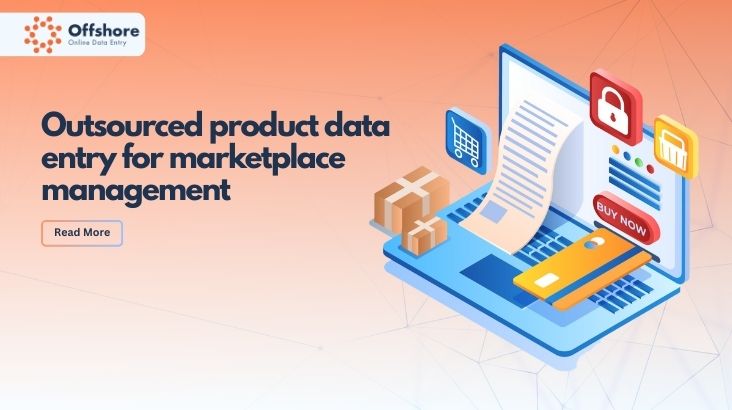
Managing product listings on various marketplaces has transcended being a mere backend chore into a growth lever. With marketplaces becoming algorithm-driven, product data entry now influences conversion, visibility, compliance, and even seller account health directly. Given this, brands scaling sustainably increasingly outsource data entry services to third-party external vendors— not just for convenience but for consistency and control.
Marketplace performance is quietly dictated by data structure
Most marketplace management algorithms fail to interpret listings the way a human would. Instead, they rely on structured data signals— taxonomy alignment, attribute completeness, variation logic, and backend dataset accuracy. That’s why outsourced product data teams are meticulously trained to work diligently within these structures rather than simply relying on surface-level keyword insertion. Here’s what they do.
- Correct attribute mapping involves category relevance scoring
- Backend fields influence beyond visible content
- Clean variation hierarchies prevent listing suppression
Once catalog data entry is done strategically, and not casually, it fosters algorithmic trust that easily compounds over time. Sellers can witness a remarkable increase in performance lift without ads or pricing, just because the data architecture becomes cleaner.
Internal teams struggle with consistency at scale
With eCommerce data entry increasing in volume, internal teams often rely on templates, multiple hands, and assumptions. As a result, data inconsistency becomes inevitable, which further get penalized across multifarious marketplaces. For example:
- Duplicate SKUs created due to naming inconsistencies
- Partial updates break parent-child relationships
- Attribute mismatches across similar products
Most marketplace product data entry outsourcing services work with standardized workflows and multi-step quality checks. More importantly, they consider consistency as a KPI and not an afterthought. The result? Reduced catalog delay and no risks of sudden performance drops.
Faster listing turnaround protects revenue windows
Timing holds the utmost importance, way more than sellers would ever nod to. Missing a promotional cycle, seasonal window, or category trend just because listings couldn’t go live on time would directly lead to massive revenue loss. This is where eCommerce listings data entry BPO solutions come to the rescue, accelerating the turnaround time for sellers of all sizes. Here’s how.
- Pre-validation slashes rejection and rework delays
- Parallel processing allows hundreds of SKUs to go live simultaneously
- Bulk uploads are meticulously structured to prevent partial failures
With marketplace outsourcing, speed can be amplified but not at the cost of accuracy, which internal teams often struggle with during high-volume periods.
Rule changes on marketplaces create hidden risks
Marketplace rules evolve constantly, mostly subtly. Restricted categories tighten, attribute requirements change, and compliance checks become stringent. However, most sellers notice these altercations once the listings get suppressed. Here, outsourced product listing services act as the rescuers, actively tracking:
- Title and image compliance changes
- Attribute mandate updates by category
- Regional listing variations and legal requirements
Thanks to this proactive alignment, silent penalties can be prevented effortlessly. Rather than reacting to issues, sellers can stay compliant by default— something in-house teams seldom achieve with static internal SOPs.
Cost savings come from error prevention, not headcount reduction
One of the biggest misconceptions sellers often have about outsourcing services is that they are only concern cheap labor. In reality, the cost savings arise due to avoided loss. Here’s how.
- Reduced negative reviews from mismatched expectations
- Fewer returns caused by inaccurate specs
- Lower ad wastage on poorly structured listings
The moment listings are accurate right from day one, sellers have to spend less time on error fixation and put more emphasis on scalability. Outsourcing transforms product data entry into a risk-mitigation workflow, not just an operational one.
Complex catalogs need specialized handling, not generalists
Variable bundles, products, kits, and region-specific SKUs are areas where catalogs break all of a sudden. Preventing these would require in-depth, accurate knowledge of the marketplace logic flows— and not just data entry speeds. For example:
- Parent-child logic should align properly with product rules
- Cross-marketplace mapping can help avoid duplication errors
- Bundled products require correct GTIN and exemption handling
Outsourced product listing teams are specifically trained to handle these situations. Thanks to this, preventing structural mistakes becomes easier, which otherwise would force sellers to rebuild the entire listings from scratch.
Conclusion
Outsourced product data entry is no longer just about delegation. Rather, it emphasizes protection, precision, and platform alignment. In marketplace environments where algorithms reward structures and buyers punish inaccuracies, clean, transparent data turns into a competitive asset. Sellers recognizing this don’t just gain proficiency in appropriate catalog management— they build marketplaces that could scale frictionlessly.
As we sail through 2025, online data entry has unlocked some interesting trends that organizations must utilize for effective data management. Like in every industry, data entry services also witness rapid transformations in how experts approach processes. Moreover, adopting modern tools and techniques into the workflow is crucial to stay relevant in the changing era. In this case, organizations should be aware of the tools and approaches online data entry solutions incorporate in their projects. Through this blog, let’s explore the trends shaping the future of data entry in 2025.

Trends in Online Data Entry Services for 2025
- Increased Adoption of AI and Automation – AI and automation are already revolutionizing online data entry services. By using AI-enabled tools, organizations can minimize human intervention, reduce errors, complete tasks quickly, and improve the overall efficiency of processes. We are already aware of the use of OCR (Optical Character Recognition), RPA (Robotic Process Automation), and NLP (Natural Language Processing) in data entry. As 2025 unfolds, the integration of such technologies increases and streamlines the process of data collection and data processing. This way, organizations become efficient in handling large volumes of data with minimal manual efforts and less turnaround times.
- Cloud-Based Solutions at the Center Stage – Cloud-based storage solution is one of the notable trends in online data entry services 2025. Cloud technology is transforming data entry by offering secure, scalable, and centralized data entry solutions. Furthermore, cloud data processing solutions provide real-time, active collaboration of team members through a single platform, from anywhere in the world. Most organizations have already adopted cloud data entry services through outsourcing. In 2025, cloud computing will become one of the vital data entry trends as it marks significant changes in the data processing realm.
- Expansion of Mobile Data Entry – Nowadays, data entry is also possible through mobile devices. With smartphones becoming more powerful and having advanced features, professionals can conveniently carry out online data entry through mobile phones. Industries offering healthcare, logistics, and field services increasingly rely on remote data entry. Here, mobile phones are substantial media for carrying out data entry. This way, organizations can reduce their dependency on desktop devices and carry out data entry tasks on mobile devices. Indeed, this is going to be one of the remarkable trends in online data entry services 2025.
- Increased Focus on Compliance and Data Security – Data security becomes a top priority of businesses as they handle vast volumes of accumulated data. By integrating data protection measures and following data privacy regulations, companies can ensure high levels of data security. In 2025, automated data entry will be carried out more consciously, with a focus on compliance and data security.
- Blockchain in Data Entry – Blockchain technology may become a game-changer for online data entry solutions. It provides a tamper-proof and decentralized ledger for storing and verifying information records. This is one of the data entry trends that are highly useful for industries like finance, supply chain, and healthcare. Moreover, blockchain technology enables automated data validation, further reducing fraud risks.
- Quantum Computing; An Emerging Frontier – While still in its early stages, quantum computing holds a promising future in online data entry. Quantum computing aids in data processing by quickly processing data, analyzing it in real-time, and flagging errors. Although research and experimentation continue, businesses have already taken steps to unlock its potential.
- Data as the Product Approach – This approach is going to be one of the crucial data entry trends for 2025. With data as the product approach, organizations consider data to be the main product rather than the byproduct of their operations. This approach is relevant mainly in industries such as mobile app development, finance, and healthcare. In addition, data as a product approach is a way for organizations to utilize and monetize data. That is, organizations utilize insights into customer behavior and experience through the data they possess and use them for strategic decision-making. This way, data is transformed into a valuable asset rather than a tool for operation.
- Less Integration of Multiple Systems – In 2025, the use of multiple systems to carry out processes in data entry may become outdated as organizations are increasingly shifting towards systems that can handle a broad range of tasks. This way, organizations can facilitate automated data entry without spending hours integrating systems. This is one of the major trends in online data entry services 2025 that is going to transform the procedures in data processing.
- Rise of Remote Data Entry – The shift towards remote data entry is one of the considerable trends in online data entry services 2025. In fact, businesses are increasingly hiring remote data entry professionals and freelancers to take care of their data. This way, organizations can reduce costs and turnaround times and ensure 24/7 assistance across different time zones. Moreover, adopting remote data entry enables organizations to access expertise while offering flexibility to workers.
The Bottom Line
The future of data entry is going to be reshaped by emerging technologies and refined approaches. Businesses that invest in such initiatives today will gain competitive advantages that boost business success. Moreover, adopting emerging trends is crucial for organizations looking to optimize their data management processes. To optimize your automated data entry efforts, collaborate with a reliable online data entry service provider.
Struggling to find the best online data entry services? Look no further, contact us at support@offshoreonlinedataentry.com and invest wisely in technologies to navigate through the future of data entry!
Every business at some point faces a big question: Should you keep managing data in-house, or is it time to team up with an offshore service provider? Both options have their perks, but they can impact your return on investment (ROI) in very different ways.
Data digitization is not just about turning paper into pixels. It is about working faster, cutting costs, improving accuracy, and keeping your core operations running smoothly. Choosing the right path helps you boost your competitive edge. Meanwhile, choosing the wrong option can result in wasted time and resources.
If you are trying to decide whether to outsource or handle digitization internally, you are in the right place. In this blog, we are going to break down the costs, benefits, and risks of each approach and help you figure out which one delivers the best ROI for your business.
What is Data Digitization and Why is it Significant?
Data digitization is the process of converting physical records like handwritten documents, images, or printed files into digital formats. The process is not just conversion; it offers several benefits, including improving accessibility, enhancing searchability, and mitigating the risk of loss or damage. Data digitization allows smooth integration with digital tools and systems, enhancing workflow efficiency and supporting prompt decision-making.
Different verticals, including healthcare, finance, legal, and retail, digitized data facilitates faster decision-making, ensures compliance, and supports data-driven insights. Digitizing records helps in easier audits, speeds up claims processing, and enables predictive analytics. Additionally, it helps businesses to quickly adapt to the marketing demands by enhancing data agility. The efficiency and accuracy of your digitization process have a direct impact on overall operational performance.
When established appropriately, data digitization benefits you in mitigating labor costs, reducing human error, and increasing customer satisfaction through quicker service delivery. Eventually, data digitization is not just an IT upgrade; it is a strategic move towards future-ready business operations.
In-house Data Digitization – Pros, Cons, and ROI
Pros
- Overall control over data and processes
- Faster internal communication
- Easier to manage quality checks and revisions
Cons
- High upfront investment in infrastructure, tools, and skilled personnel
- Existing teams may face bandwidth constraints
- Scaling up is costly and time-intensive
ROI Considerations
While in-house digitization ensures control, it comes at a premium. If you have a consistent workload and a trained team, the long-term investment might pay off. However, productivity issues, staffing shortages, and downtime can significantly erode returns. Additionally, if digitization isn’t your team’s core expertise, error rates may increase.
Offshore Data Digitization: Pros, Cons, and ROI
Pros
- Significant cost savings on labor and infrastructure
- Access to experienced professionals for faster, more accurate output
- Flexible scaling based on project demands
- Time zone advantages allow work to continue around the clock
Cons
- Requires strong data security and compliance protocols
- Communication barriers may occasionally arise
- Selecting a reliable offshore partner takes effort and research
ROI Insights
Offshoring can lead to substantial savings and faster delivery. Experienced offshore teams typically operate with efficient workflows, automation tools, and predictable pricing. With a reliable provider, you can expect lower error rates, faster turnaround, and better budget planning.
Key ROI Metrics to Evaluate
When comparing offshore and in-house digitization, consider the following metrics:
- Cost per record digitized: Offshore teams often provide a lower cost per unit.
- Turnaround time: Offshore providers typically complete projects faster with dedicated teams.
- Error rates: Professional vendors maintain strict quality standards.
- Technology adoption: Offshore providers often use automation tools to accelerate the process.
- Impact on core operations: In-house efforts may divert focus from core business functions.
Strategies to Consider Before Choosing
The following are certain factors to consider before choosing in-house vs. offshore Data Digitization:
- Data sensitivity and stringent compliance standards like HIPAA or GDPR.
- The scale of your digitization requirements.
- The ability of your internal team to manage the workload without disrupting core operations.
- Your potential to invest in technology and skilled talent for an internal setup.
- The ability of your in-house team to meet tight deadlines.
- Offshore teams have the potential to deliver around the clock.
Takeaway
Deciding between offshore and in-house data digitization cannot be applicable to every business alike. Managing processes in-house provides control but requires considerable investment and time. Hiring offshore service partners offers benefits in terms of scalability, speed, and cost-effectiveness. However, it requires careful evaluation and trustworthy partnerships. Ultimately, ROI depends on more than just cost; it also considers output quality, speed, and how digitization aligns with your broader business goals. For the majority of businesses, offshore digitization offers a better return on investment (ROI), particularly for large-scale, repetitive tasks.
Looking for a reliable partner for your data digitization needs? Then, Offshore Online Data Entry is your perfect choice. Connect with us at support@offshoreonlinedataentry.com to know more.
Allianze Infosolutions- Your Trusted Partner For Business Needs
Allianze Infosolutions is not just another BPO service provider- we can be your strong ally for scalable, accurate, and budget-friendly BPO services. As the best BPO services in USA, we offer customized business process outsourcing services for clients in the USA and worldwide. We design our services in such a way that they can take away your burden and free up your resources for core functions in your company. Our experts will talk with you clearly, understand your requirements, goals, and interests, and will work in your time zone to drive out the maximum. Whether you are a person who runs a startup or a large enterprise, Allianze Infosolutions can take your business to new heights with our reliable services.